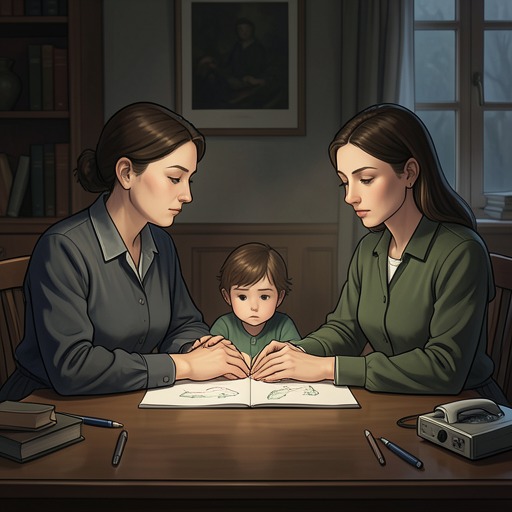
Kathy’s unresolved grief over Hope
The Birthday PartyKathy Hamilton’s unresolved grief over Hope begins with a daughter she was compelled to give up as a teenager and continues through years of silence, unsuccessful searches, and memories that surface in her relationships with her other daughters. When Kathy finally tells Megan Carter what happened, the account gives Hope a place in their family history that had long been denied to her. It does not resolve the loss, but speaking makes the child feel present again—and helps Kathy recognize how concealment and family pressure have carried consequences across generations.
The Pregnancy and Forced Adoption
Kathy was seventeen when she became pregnant. Her mother, Connie Hamilton, could not bear the prospect of her unmarried daughter raising a child and feared the judgment of her church friends. Kathy says she had no real choice: keeping the baby was not an option, and neither was an abortion. She had taken months to gather the courage to tell Connie; until then, pregnancy had not been only a source of fear. Kathy recalls feeling less alone as the baby grew and singing to her. When her pregnancy became visible, Connie told Kathy’s father, Jack Miller, on her behalf. Jack was so disappointed that he barely spoke to Kathy until after the birth.
By the time labor came, Kathy knew she wanted to keep her daughter, but also believed her parents would never permit it. After the birth, the family behaved as if the baby had never existed. The adoptive parents chose a name Kathy was never told. She had privately hoped to call her daughter Hope Hamilton, a name that joined the child to the family from which she was being separated even as the adoption placed her elsewhere.
Kathy was allowed only ten minutes with the newborn before handing her to a case worker. The couple who would take the baby home waited in another room; Kathy did not meet them or get to suggest the name she had chosen. She remembers Hope as weighing six pounds and eight ounces, with no hair and large brown eyes. These few details stand out against the years in which the family treated the child as though she had never existed.
Grief Kept in Silence
The loss continued after the adoption. Kathy describes weeks and months of loneliness and emptiness, and an instinctive search for the baby in rooms where she knew Hope did not live. Her arms ached to hold and feed a child, and her body continued to produce milk. Having Fay later did not erase the absence: instead, motherhood brought reminders of milestones Kathy had missed with Hope, including a first step, a first word, and the first day of school.
Kathy rarely allowed herself to think about her first daughter. When she finally speaks to Megan, the disclosure is difficult, but the words come quickly once she has begun. Megan listens and offers comfort, while recognizing that the pain cannot be answered with easy reassurance. Their conversation also gives Megan a way to understand the depth of a parent’s distress during Charlie’s disappearance; Kathy’s account of losing Hope makes the uncertainty surrounding Charlie more personally legible to her.
Afterward, Kathy reflects that talking about Hope felt wonderful despite the force of the emotions it brought back. In her view, not speaking of a child who was taken away can make it seem as though the child never existed. Telling Megan restores Hope to the family’s spoken memory, though it does not undo the separation or settle what became of her.
The Search That Remains Open
Kathy has made several unsuccessful attempts over the years to trace Hope. Connie told her the adoption was closed, so no information was shared about what happened after the baby was placed with her adoptive family. The lack of information gives Kathy no confirmed account of Hope’s later life and no name by which to continue the search. Speaking with Megan renews Kathy’s attention to the possibility of finding her daughter, but she first intends to focus on Charlie and Fay and to wait until the immediate family crisis has passed.
The adoption’s secrecy shapes the grief as much as the original separation. Kathy can recall the brief time she held Hope and the name she wanted for her, but cannot connect those memories to the identity or circumstances of the family who raised her. Her hope of learning more remains conditional and unresolved, not a reunion already achieved.
Family Consequences and Inherited Silence
Kathy’s private loss sits within a wider pattern of family conflict. She learns that her therapist connected her food-related difficulties to the arguments she witnessed while growing up. Looking at Fay’s anxiety, Kathy fears that her own marriage has repeated aspects of her parents’ troubled relationship: she had concealed Mitch Hamilton’s affair rather than confronting the crisis, and wonders whether a different choice might have spared Fay some distress. Her conclusion is that she must break the cycle rather than pass its effects to another generation.
The confrontation with Connie exposes how the original decision still divides the family. Connie says she had believed the baby would eventually destroy the family; Kathy answers that forcing her to give the child up took away her choice and affected both her life and Megan’s. Kathy also connects Connie’s control over her teenage relationship with Chase Cooper to the events that followed, arguing that, had she been allowed to be with Chase, she would not have become involved with Evan Harris. This is Kathy’s understanding of the chain of consequences, voiced in the midst of a painful confrontation rather than as an independently established certainty.
The consequences reach the Hamilton name itself. In the aftermath of Connie’s betrayal, Fay says she no longer wants to be a Hamilton, and Kathy suggests Fay Carter as a name with a better sound. Jack approves. Mitch, who has moved out and found a place of his own, is also ready to return to the Bowers name. These changes do not erase Hope’s history, but they mark a break with the family identity that had concealed her and placed reputation above Kathy’s choice. Kathy’s grief remains unresolved; what changes is that the story of Hope is no longer wholly confined to silence.